Terminal Cleaning in Healthcare: What It Means, When It’s Needed, and What to Require
Learn what terminal cleaning means in healthcare, when it is needed, what it includes, and what to require from a medical cleaning vendor.
Terminal cleaning in healthcare isn’t just a more detailed version of routine cleaning.
For hospitals, surgery centers, outpatient procedure rooms, and other medical facilities, terminal cleaning is a crucial cleaning and disinfection process designed to reset a space before the next patient, case, or clinical use.
That makes the stakes higher than a standard janitorial checklist.
A proper terminal clean depends on clear protocols, trained staff, defined handoffs with clinical teams, and documentation that shows the work was completed correctly. Without that structure, important surfaces can get missed, responsibilities can be dropped between teams, and facility leaders are left uncertain whether the room is ready.
This guide explains what terminal cleaning means in healthcare, how it differs from routine cleaning, when it is typically needed, and what it usually includes.
Plus it shows you what to require from a medical cleaning vendor before you trust them with higher-risk spaces.
[Quick note: This article is a general guide for healthcare facility leaders. For complete, current healthcare environmental cleaning guidance, refer to the CDC’s healthcare environmental cleaning resources and your facility’s internal infection prevention policies.]
What terminal cleaning means in healthcare
Terminal cleaning is a more complete cleaning and disinfection process used after specific events or at defined times in healthcare settings. It is meant to reset a room or care area before the next patient, next case, or next use.
CDC describes terminal cleaning of inpatient areas as occurring after a patient is discharged or transferred. The process includes the patient zone and the wider patient care area, with the goal of removing organic material and reducing microbial contamination before the next patient uses the space.
That last part is the key. Terminal cleaning is not a vague upsell. It is tied to patient care workflows.
It also does not mean sterilization. Cleaning vendors may clean and disinfect environmental surfaces, floors, and defined noncritical equipment surfaces. They should not be positioned as performing clinical sterilization, instrument reprocessing, or other tasks that belong to trained clinical or sterile processing teams.
Terminal cleaning vs routine cleaning
Routine cleaning keeps the facility clean during normal operations. Terminal cleaning is a more complete reset after certain patient care events or at the end of the day in specific areas.
The difference matters because the staffing, timing, surface coverage, and documentation may all change.
CDC separates routine, terminal, and scheduled cleaning in healthcare patient areas and recommends different frequencies and processes based on room type, contamination risk, patient vulnerability, and whether surfaces are high-touch or low-touch.
Routine cleaning
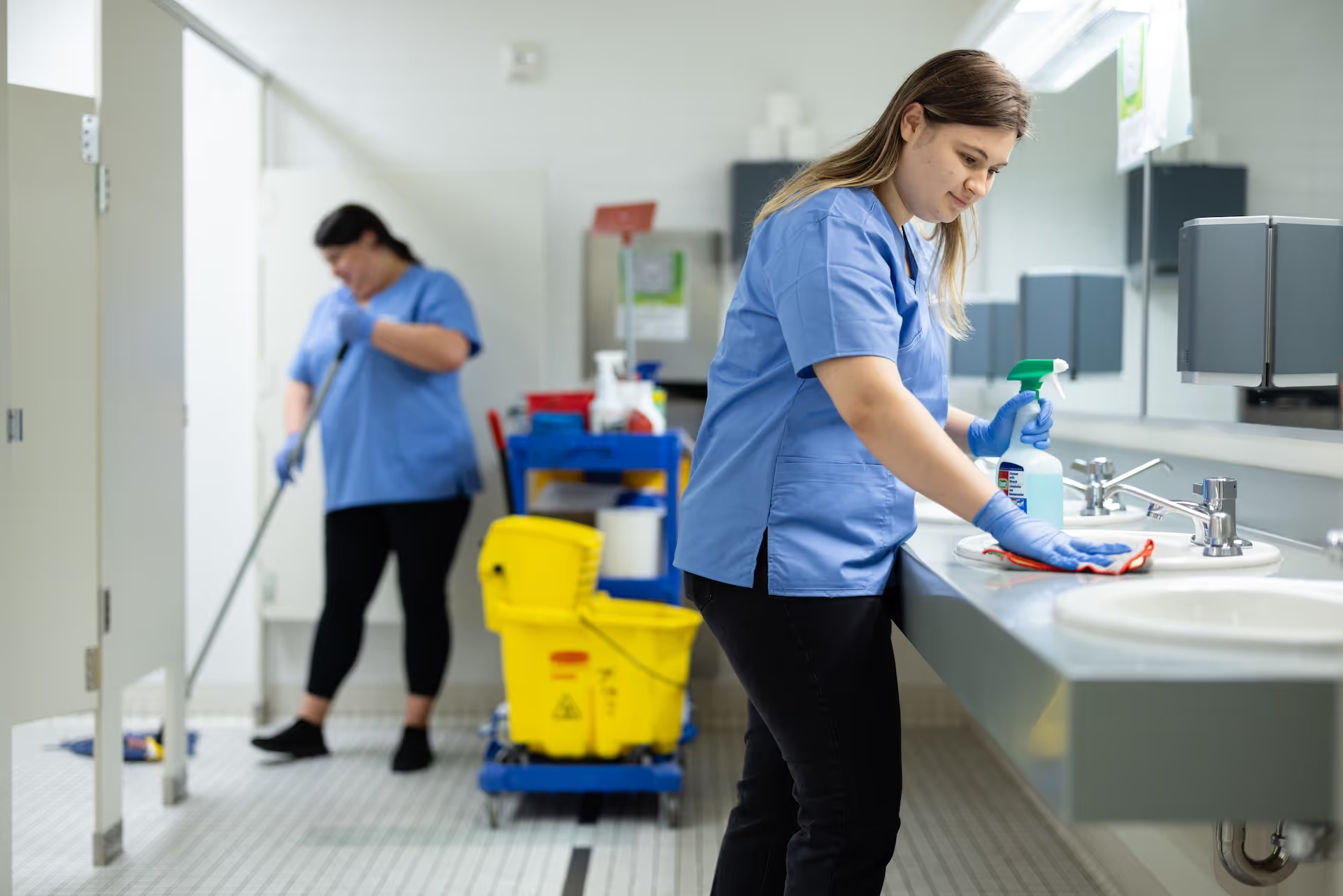
Routine cleaning happens on a recurring schedule. It usually focuses on high-touch surfaces, restrooms, waiting areas, floors, visible soil, trash, and the areas that need regular attention to keep the site running.
In outpatient settings, routine cleaning might include waiting rooms, consultation rooms, exam rooms, restrooms, staff areas, and public touchpoints. CDC’s outpatient guidance describes daily cleaning for waiting and admission areas, more frequent cleaning for consultation or examination areas, and cleaning and disinfection before and after minor procedures.
Routine cleaning is essential. But it is not the same as a terminal clean.
Terminal cleaning
Terminal cleaning is more complete and more protocol-driven. It may include surfaces and areas that are not addressed as deeply during a normal shift, especially because equipment, beds, procedure tables, or patient belongings may block access during routine cleaning.
CDC’s general terminal cleaning process includes removing or reprocessing designated items, cleaning and disinfecting low-touch and high-touch surfaces, addressing areas that may not be accessible while a room is occupied, cleaning floors, and cleaning and disinfecting handwashing sinks. (CDC)
A good way to think about it: routine cleaning maintains the space. Terminal cleaning resets it.
When terminal cleaning is needed
Terminal cleaning is usually tied to a trigger. That trigger might be a patient discharge, the end of a procedure day, the final case in an operating room, or the use of a space that requires a more complete reset.
The exact requirements should always follow the facility’s protocols, room type, patient population, and infection prevention policies. CDC’s guidance uses a risk-based approach, factoring in the probability of contamination, patient vulnerability, and potential exposure through high-touch and low-touch surfaces.
Common terminal cleaning triggers include:
- After patient discharge or transfer in inpatient areas
- At the end of the day in certain exam, treatment, or minor procedure rooms
- After the final procedure in an operating room or surgery center
- After use of certain isolation or transmission-based precaution rooms
- After blood or body fluid contamination, depending on facility policy and room type
- Any time a facility protocol calls for a full room reset before the next patient or use
The safest language is “may be required” or “commonly used,” because terminal cleaning protocols vary by facility. The important thing is that the trigger is clear before the work begins.
What terminal cleaning usually includes
The exact scope should be defined by the facility, the room type, and the approved cleaning protocol. But a proper terminal clean is usually broader than the daily checklist.
CDC’s terminal cleaning process for inpatient rooms includes cleaning and disinfecting both low-touch and high-touch surfaces, including surfaces that may not be accessible when the room is occupied, plus floors and handwashing sinks. For operating rooms after the final procedure, CDC lists cleaning and disinfecting horizontal surfaces, fixed equipment, handwashing sinks, scrub areas, utility areas, the entire floor, baseboards, and other surfaces as needed.
A terminal clean may include:
- Removing waste, soiled materials, or disposable items as defined by facility policy
- Cleaning and disinfecting high-touch surfaces
- Cleaning and disinfecting low-touch or less accessible surfaces
- Cleaning fixed equipment surfaces within the approved scope
- Cleaning under and around movable equipment where appropriate
- Cleaning and disinfecting sinks, scrub areas, or utility areas where relevant
- Cleaning the full floor, including edges and areas normally blocked by furniture or equipment
- Final inspection, sign-off, or documentation
This is where clarity matters. A vendor should know what they own, what clinical staff owns, and what needs to be escalated instead of guessed.
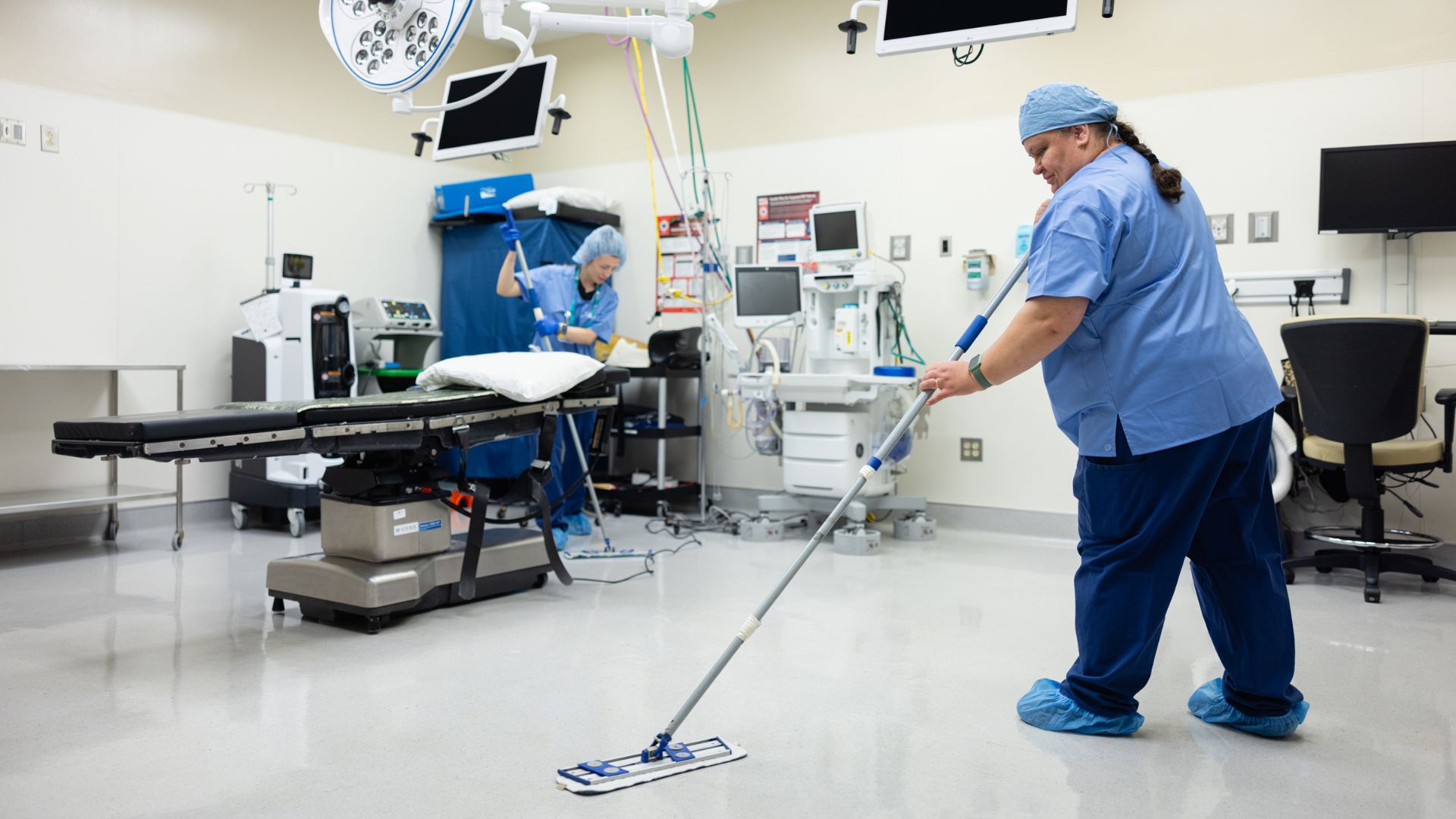
Terminal cleaning in operating rooms and surgery centers
Operating rooms and surgery centers bring a different level of operational pressure. The rooms are specialized, the schedules are tight, and missed details can create stress for everyone downstream.
CDC says operating rooms require environmental cleaning at three distinct intervals: before the first procedure, between procedures, and after the last procedure, which is the terminal clean. CDC also notes that operating rooms are highly specialized areas and that clinical staff often manage or participate in environmental cleaning, while critical and semi-critical equipment require specialized reprocessing and are never the responsibility of environmental cleaning staff.
That boundary is important.
A healthcare cleaning vendor can be a strong partner for environmental surfaces, floors, fixed equipment surfaces, and defined room areas. But the vendor should not blur the line into instrument reprocessing, sterilization, or clinical responsibilities.
In a surgery center, the best vendor is not the one that says, “We handle everything.” It is the one that says, “Let’s define the room, the surfaces, the sequence, the handoffs, and the documentation so nothing gets missed.”
Who is responsible for terminal cleaning?
Terminal cleaning often requires more than one team. That is why the handoff matters as much as the cleaning itself.
CDC says terminal cleaning requires collaboration between cleaning, infection prevention, and clinical staff to define responsibility for every surface and item. CDC also says responsible staff should be identified in checklists and SOPs so items are not overlooked because of confusion.
In practical terms:
- Cleaning or EVS staff may own environmental surfaces, floors, restrooms, and defined noncritical surfaces
- Clinical staff may own patient care equipment, sensitive devices, instruments, and specialized reprocessing
- Infection prevention or facility leadership may define protocols, approved products, quality expectations, and documentation requirements
- Vendor supervisors may own training, staffing, completion logs, inspections, and corrective actions
The worst-case scenario is not always that someone refuses to do a task. Sometimes the task simply falls between teams because nobody wrote down who owns it.
Product instructions and contact time matter
Terminal cleaning is not only about wiping the right surfaces. It is also about using approved products the right way.
The Joint Commission says organizations are expected to provide access to the information needed to support infection prevention and control, including instructions for use for cleaning and disinfection. It also says accredited organizations must follow product instructions for quality control, including dilution, exposure times, efficacy testing where applicable, and acceptable process ranges.
That is why staff should not be guessing about disinfectants, contact time, dilution, or compatibility with surfaces and equipment.
For a vendor, this means the team needs training, site-specific instructions, and easy access to the products and protocols the facility has approved. For the client, it means those expectations should be built into the scope and documentation from the start.
What documentation should come with terminal cleaning?
A terminal clean that is not documented can be hard to verify later. That is a problem for facility leaders who need confidence, not just verbal reassurance.
Terminal cleaning documentation should connect the work, the staff, the room, the products, and the quality process.
It doesn’t need to be complicated. But it does need to be clear.
A strong terminal cleaning program should include:
- Written SOPs by room type
- Terminal cleaning checklists
- Defined triggers for when terminal cleaning is required
- Approved product and equipment instructions
- Staff training records
- Completion logs
- Supervisor inspections or QA checks
- Corrective-action notes when something is missed
This documentation helps the facility see that the process is repeatable. It also makes vendor oversight easier, which is one of the biggest benefits healthcare buyers are really looking for.
What to ask a healthcare cleaning vendor
A good vendor conversation should move quickly from “Yes, we do terminal cleaning” to “Here is how we do it.”
That is the difference between a vendor who understands healthcare work and one who is trying to make ordinary deep cleaning sound clinical.
Ask questions like:
- What types of healthcare spaces have you supported?
- Have you worked in exam rooms, procedure rooms, operating rooms, recovery areas, or isolation rooms?
- Can you provide a written terminal cleaning checklist?
- How do you train staff on terminal cleaning protocols?
- How do you define responsibilities between your team and clinical staff?
- How do you handle high-touch surfaces and equipment boundaries?
- How do you document completed terminal cleans?
- How do you verify quality after the work is done?
- What happens if a terminal clean is missed or needs correction?
- How do you adapt to our approved products, schedules, and protocols?
The answers should feel specific. If they stay vague, that is usually a sign the process is not mature enough for a healthcare environment.
Red flags to watch for
Terminal cleaning is too important to leave to assumptions. A vendor does not need to sound overly technical, but they should be able to explain their process clearly.
Watch for red flags like:
- They describe terminal cleaning as “just deep cleaning”
- They do not use written checklists
- They cannot explain staff training
- They do not document completed work
- They blur the line between environmental cleaning and clinical reprocessing
- They cannot explain high-touch surface priorities
- They do not clarify equipment boundaries
- They have no supervisor review or corrective-action process
- They resist following facility-approved protocols
A serious healthcare cleaning partner will not be threatened by these questions. They will welcome them, because they already know the details matter.
The bottom line
Terminal cleaning is not a vague add-on. It is a healthcare cleaning process that needs clear protocols, trained staff, defined responsibilities, and reliable documentation.
The right vendor should help your facility reduce guesswork. They should be able to walk the space, understand the room types, work within your approved protocols, clarify handoffs with clinical staff, and document the work in a way that supports internal reviews and outside inspections.
For healthcare leaders, that is the real value.
Not just a cleaner room. A process you can trust.
If your facility needs terminal cleaning support, start with a site walk. The right partner should be able to review your room types, schedules, risk areas, and documentation needs before recommending a scope.
FAQ
What is terminal cleaning in healthcare?
Terminal cleaning is a more complete cleaning and disinfection process performed after certain patient care events, such as patient discharge, transfer, or the final procedure of the day. It typically includes high-touch surfaces, low-touch surfaces, floors, fixed equipment, and areas that may not be fully accessible during routine cleaning.
Is terminal cleaning the same as deep cleaning?
No. Deep cleaning is a general phrase. Terminal cleaning is a healthcare-specific process tied to room type, patient care events, facility protocols, and infection prevention expectations.
When is terminal cleaning required?
It depends on the setting and facility policy. Terminal cleaning is commonly used after discharge or transfer in inpatient areas, after the final procedure in operating rooms or procedure rooms, and in higher-risk spaces where a complete room reset is required.
What is included in a terminal clean?
A terminal clean may include cleaning and disinfection of high-touch surfaces, low-touch surfaces, fixed equipment surfaces, sinks or scrub areas, floors, and areas normally blocked by furniture or equipment. The exact scope should be defined by room type and facility protocol.
Who performs terminal cleaning?
Terminal cleaning may be performed by EVS staff, an outside healthcare cleaning vendor, clinical staff, or a combination of teams. Responsibilities should be clearly defined in SOPs and checklists so surfaces, equipment, and handoffs are not missed.
Does terminal cleaning include sterilization?
No. Terminal cleaning supports environmental cleaning and disinfection, but it does not replace clinical sterilization, instrument reprocessing, or other specialized clinical responsibilities.
What documentation should a terminal cleaning vendor provide?
A vendor should be able to provide SOPs, checklists, training records, completion logs, product instructions, QA reports, and corrective-action documentation where applicable. This documentation helps make the process visible and easier to verify.
Why is terminal cleaning important in surgery centers?
Surgery centers depend on clean, ready rooms to keep cases moving safely and on schedule. Terminal cleaning helps reset operating and procedure spaces after defined events, especially when paired with clear roles, trained staff, and facility-approved protocols.
Learn what ambulatory surgery center cleaning should include, how to define responsibilities, and what to require for reliable, audit-ready service.
Read More
Learn what medical office cleaning costs in the Seattle area, what affects your quote, and how to compare proposals for dependable healthcare cleaning.
Read More
Learn how trained staff, clear protocols, fast response, and documented quality help Seattle healthcare facilities stay clean and ready. Schedule a site walk.
Read More
Looking for commercial cleaning services in Seattle? Learn how a dependable janitorial partner makes your life easier, from daily cleaning to QA and communication.
Read MoreLearn what terminal cleaning means in healthcare, when it is needed, what it includes, and what to require from a medical cleaning vendor.
Read More
Learn what audit-ready healthcare cleaning documentation should include, from schedules and SOPs to training records, QA logs, and corrective actions.
Read More
Learn what HIPAA-compliant cleaning really means for medical offices and clinics, including vendor access rules, privacy safeguards, incident protocols, and what to require.
Read More
Hiring medical office cleaning services in Seattle? Use this checklist for scope, high-touch disinfection, turnover handoffs, logs, and QA. Request a site walk.
Read More
Best practices for clinic cleaning services: high-touch priorities, waiting rooms, restrooms, shared equipment boundaries, and checklists. Request a site walk.
Read More
Hospital janitorial services explained: what EVS covers, what to outsource, scope boundaries, and inspection-ready documentation. Request a walkthrough.
Read MoreGet 100%
Dependable
Cleaning
Make the switch to a professional janitorial team that comes through for you every time. No more missed cleans or constant turnover. Schedule a site walk today and make cleaning stress a thing of the past.